Instagram influencer marketing is a brand partnership with a creator who promotes a product, service, or message through content for their audience. This guide helps US brand teams define the strategy before they source creators, negotiate terms, or manage publishing.
The intended output is a documented strategy brief: one primary objective, a clear audience, a creator and content direction, operating guardrails, and a measurement plan. A strong setup makes subsequent creator selection and campaign execution more focused—and prevents teams from treating follower count, likes, and sales as interchangeable signals of success.
Quick answer
To set up an Instagram influencer marketing campaign, choose one primary business objective, define the target audience and desired action, select a creator and content approach that fits that goal, document message and disclosure guardrails, and agree on KPIs and tracking before sourcing creators.
Decision rule
Let the campaign objective determine the audience action, creator-content approach, and KPI—not the other way around.
- When The goal is broad awareness or message recall
- Prioritize relevant audience reach and memorable creator-led content; evaluate with awareness-oriented delivery measures.
- When The goal is consideration or education
- Prioritize credible creators and formats that demonstrate the product, answer questions, or show a relevant use case; evaluate meaningful engagement and interest signals.
- When The goal is traffic, leads, or sales
- Plan the destination, tracking identifiers, attribution method, and conversion definition before launch; choose content with a clear, appropriate call to action.
- When Follower count is the main reason to select a creator
- Pause and validate audience alignment, topical relevance, credibility, content fit, brand safety, and capacity first.
Comparison
| Criterion | Awareness | Consideration / engagement | Traffic / leads | Conversion |
|---|---|---|---|---|
| Primary audience action | Notice or remember the message | Learn, engage, save, share, or seek more information | Click through or submit details | Complete a defined commercial action |
| Creator-content emphasis | High-relevance storytelling and broad visibility | Demonstration, explanation, review, or use-case content | Clear value proposition and a natural route to a destination | Credible product fit, clear offer, and measurable path to action |
| Primary KPI examples | Reach, impressions, views | Meaningful engagement, saves, shares, profile visits | Tracked clicks, sessions, lead completions | Attributed conversions, orders, revenue |
| Pre-launch requirement | Define the target audience and delivery measurement window | Define what engagement signals indicate useful interest | Set links, tags, landing pages, and lead definitions | Define conversion, attribution rules, and data source |
Instagram Influencer Marketing: Strategy Setup for Brands
Influencer marketing is a form of marketing in which a brand collaborates with an influencer to promote products or services through social content. On Instagram, the strategic question is not simply, “Which creator has the most followers?” It is whether a creator can credibly help a defined audience take the action your campaign needs.
Use this guide to set up the campaign strategy. It covers objectives, audience definition, creator and content direction, guardrails, and measurement. It does not provide a creator-sourcing workflow, individual vetting, outreach, price negotiation, contract drafting, day-to-day publishing management, or post-campaign optimization.
That boundary matters: follower count alone is not a reliable measure of influence or creator fit. Relevance, audience alignment, credibility, and the role content plays in the customer journey all deserve consideration.
Set the Campaign Objective and Define Success
Start with one primary objective. A campaign can produce several effects, but it needs a single priority to guide trade-offs in creator mix, formats, budget allocation, and reporting.
Choose the objective that reflects the business problem:
| Primary objective | Desired audience action | Examples of primary measures |
|---|---|---|
| Awareness | Notice or remember the brand, product, or message | Reach, impressions, video views, view-through measures where available |
| Engagement or consideration | Save, share, comment, visit a profile, or seek more information | Meaningful engagement, saves, shares, profile visits, qualified responses |
| Traffic or lead generation | Click through to a destination or submit details | Tracked clicks, landing-page sessions, completed lead actions |
| Conversion | Purchase or complete another defined commercial action | Attributed orders, revenue, qualified conversions, cost per defined outcome |
Write an objective statement that includes the audience and desired outcome: “Increase consideration among [audience] by using creator content that demonstrates [benefit or use case].” Then name the one measure that will determine whether the campaign met its primary goal.
Do not promise universal benchmark ranges, creator fees, or performance thresholds without reliable campaign-specific evidence. The supplied materials do not establish current Instagram-specific benchmarks or pricing. Use your historical performance, unit economics, and media context to set targets instead.
Define the Audience and Instagram’s Role in Their Journey
Define the audience in enough detail to make creator and content decisions. “Women ages 18–34” is usually too broad on its own. Include the factors that affect message relevance:
- Who: relevant customer segment, life stage, professional role, or community
- Need or occasion: the problem, aspiration, or moment that makes the offer relevant
- Context: location, language, product category, and purchase constraints where relevant
- Current relationship: unaware, evaluating alternatives, existing customer, or ready to buy
- Desired next action: watch, save, visit, sign up, shop, or another specific action
Next, state Instagram’s job in the journey. For example, creator content may introduce an unfamiliar product, show how it fits into a real routine, answer common objections, or provide a clear route to a campaign destination. This prevents a mismatch such as demanding immediate sales from content designed primarily to build familiarity.
A practical audience statement might read: “Reach US home cooks who want faster weeknight meal options, are open to new pantry products, and need a credible demonstration before visiting a retailer or product page.”
Choose a Creator and Content Strategy
Set selection criteria before looking at individual accounts. A large audience may be useful when broad exposure is the priority, but it does not automatically indicate relevance, trust, or commercial impact. Start with the campaign audience and intended action.
Define the creator profile
Describe the creator attributes that matter for this campaign:
- Topic, lifestyle, expertise, or community relevance
- Audience overlap with the target segment
- Content style and ability to explain, demonstrate, entertain, or inspire as needed
- Credibility of the product fit within the creator’s usual content
- Appropriate reach needs and feasible creator mix
- Brand-safety standards and prohibited associations
- Ability to work within required timing, production, and approval constraints
Use creator tiers as a planning variable, not the strategy itself. Smaller, focused creators can be appropriate where community relevance and credible use cases matter; larger creators can be appropriate where broader visibility is needed. Test the proposed mix against the objective rather than assuming one tier always performs best.
Match the content format to the audience action
Choose a small number of formats based on what the audience needs to see or do:
- Demonstration or tutorial: useful when product understanding or proof is the barrier.
- Routine or lifestyle integration: useful when the goal is to make the product feel relevant in a real context.
- Comparison, review, or problem-solution story: useful during consideration, subject to substantiation rules.
- Story-led reminder or call to action: useful when a timely click, visit, or redemption action is central.
- Creator-led series: useful when repeated exposure, education, or a longer association supports the objective.
Specify the collaboration model as well. A one-off activation can fit a time-bound launch or message test. A longer-term partnership can fit a category that benefits from repeated demonstrations and audience familiarity. Neither model is inherently better; choose the one that provides enough time and content volume for the stated goal.
Creator content commonly works because the message is embedded in the creator’s own materials and relationship with their audience. Preserve room for the creator’s voice while defining non-negotiable accuracy, safety, and disclosure requirements.
Build the Strategy Brief and Operating Guardrails
Create a concise written brief that provides direction without scripting away the creator’s voice. Before outreach begins, the team should be able to answer the following:
- Objective and audience: What is the primary outcome, who is the campaign for, and what should that audience do?
- Core message: What product benefit, proof point, offer, or use case must be communicated? Which claims, comparisons, or topics are prohibited?
- Creator and content direction: What creator profile, formats, platforms, approximate content volume, and collaboration model are planned?
- Resources: What budget range, product inventory, creative assets, landing pages, tracking support, internal expertise, and turnaround time are available?
- Ownership and approvals: Who owns the strategy, who can approve claims and creative direction, and who can resolve a risk or timing conflict?
- Usage expectations: Is the brand seeking only creator publishing, or does it anticipate requesting permissions to reuse content? Record the intended need early; the exact rights and terms are handled later in the written partnership process.
- Authenticity boundaries: Which elements are mandatory, and where can creators adapt the concept to their own style and audience?
Disclosure and compliance guardrails
For US campaigns, treat paid, gifted, affiliate, or otherwise material commercial relationships as a disclosure issue to resolve before work begins. Creator advertising should make the commercial relationship clear to the audience; transparency also helps protect the authenticity of the partnership.
Do not rely on a generic checklist as legal advice. Verify current FTC guidance, relevant platform tools, sector-specific rules, and the facts of the specific arrangement with qualified internal or external reviewers before launch. Put disclosure responsibilities, approval boundaries, and escalation ownership into the brief, then address the final terms in the partnership documentation.
Create a Pre-Launch Measurement Plan
Measurement should reflect the primary objective selected at the start. Build a small KPI set rather than a report full of disconnected platform metrics.
Define the measurement structure
For each campaign, document:
- Primary KPI: the metric used to judge the campaign’s central objective
- Supporting KPIs: measures that explain delivery or audience response without replacing the primary KPI
- Data source: native Instagram reporting, creator-provided analytics, web analytics, CRM, ecommerce data, or another agreed source
- Tracking method: campaign tags, creator-specific links, landing pages, codes, or other identifiers where appropriate
- Baseline or target: historical results, forecast assumptions, or a defined business threshold
- Measurement window: when results will be collected and assessed
- Known limitations: attribution gaps, delayed conversion, unavailable data, overlap with other marketing, or differences in reporting access
For a traffic campaign, a tracked landing-page visit may be primary while reach and saves help explain performance. For an awareness campaign, reach and viewing measures may be primary; do not judge it only by purchases. For a conversion campaign, define what counts as a conversion and how it will be attributed before content is live.
Set decision rules in advance
Agree on decisions that the results will support. For example:
- Continue or expand a creator-content direction when it meets the primary KPI and remains within the planned cost or resource constraints.
- Investigate when delivery is strong but the intended audience action is weak; the issue may be message clarity, destination experience, offer relevance, or tracking—not necessarily the creator.
- Reassess the strategy when results cannot be interpreted because a tracking input, baseline, or approval of metric definitions was missing.
Creator campaigns can contribute to performance across the funnel, but the supplied evidence does not establish a universal outcome for every brand or campaign. Use the plan to evaluate your campaign against its own objective and documented assumptions.
Review the Launch-Ready Instagram Influencer Marketing Strategy
Use this checklist before beginning creator sourcing:
- One primary campaign objective and success measure are documented.
- The target audience, need state, and desired action are specific.
- Instagram’s role in the audience journey is defined.
- The creator profile and content formats match the objective—not just a follower-count preference.
- The proposed collaboration model and resource assumptions are realistic.
- Mandatory messages, prohibited claims, authenticity boundaries, and brand-safety expectations are written down.
- A responsible owner, approvers, and escalation path are assigned.
- Disclosure and compliance requirements will be checked against current applicable guidance.
- Tracking, data sources, baselines, measurement window, and decision rules are set.
If a box remains unchecked, resolve it before approaching creators. The next stage is to identify and assess candidates against this strategy, then document the commercial and operational details needed to execute the campaign.
Conclusion
A launch-ready Instagram influencer marketing strategy is not a list of potential creators. It is a set of decisions that makes creator selection and campaign execution purposeful: one priority outcome, a defined audience action, a suitable creator-content approach, clear boundaries, and a measurement plan agreed before launch.
Once those decisions are documented, move to sourcing, partnership terms, content review, and publishing operations with a clearer basis for trade-offs and accountability. For the next operational phase, see the step-by-step influencer marketing campaign playbook.
AhaCreator
From creator matching to payment. One connected workflow.
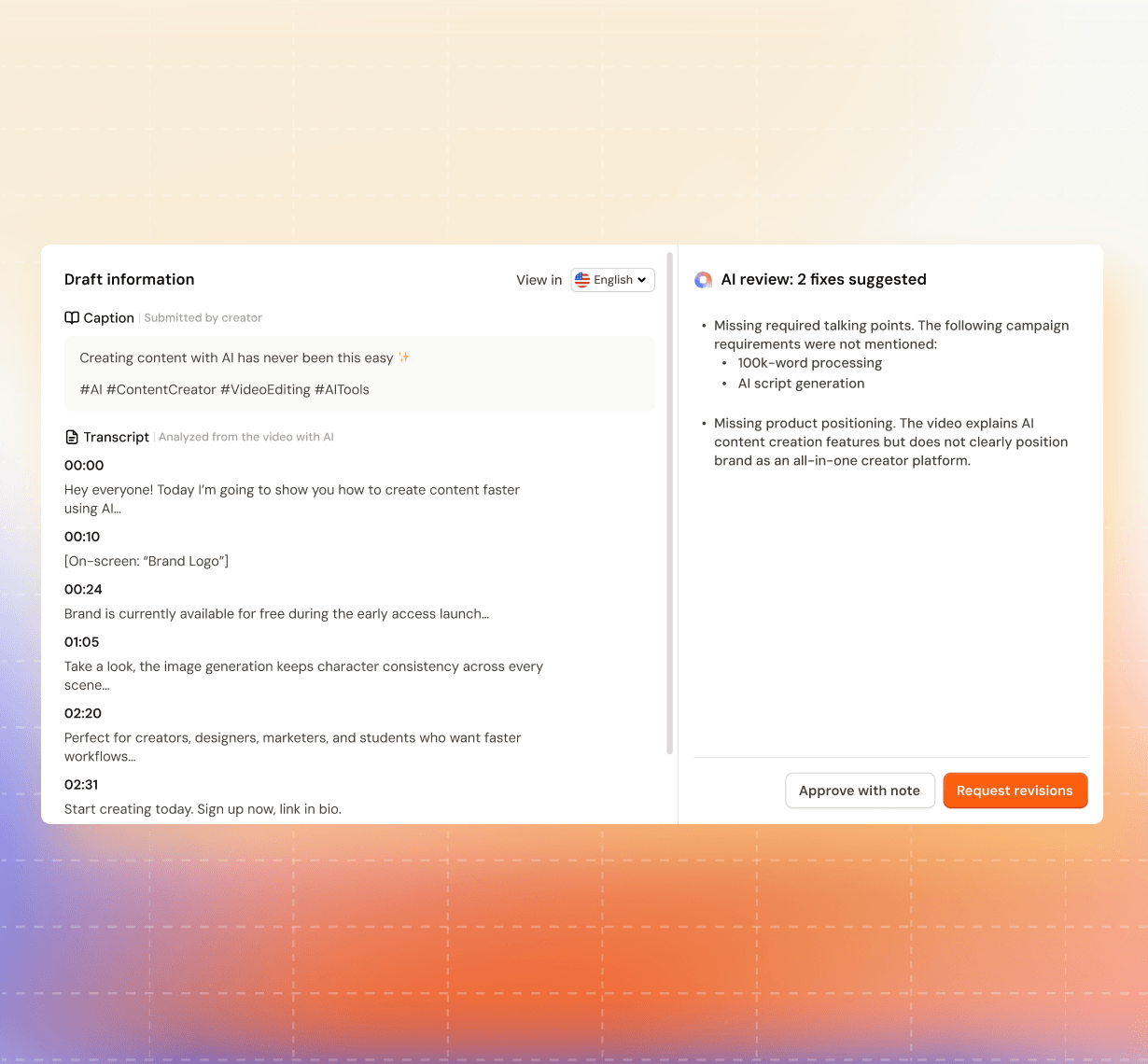
Bring outreach, negotiation, contracts, content review, and campaign tracking together with AhaCreator. Pay creators through the platform and explore how AI supports your team at each stage of a collaboration.
Frequently asked questions
Questions, answered
What is Instagram influencer marketing?
Instagram influencer marketing is a brand collaboration with a creator who promotes a product, service, or message through social content for their audience. Effective programs prioritize audience relevance, credibility, and content fit rather than treating follower count as the only indicator of influence.
How do I choose an objective for an Instagram influencer campaign?
Choose one primary objective that reflects the business problem: awareness, engagement or consideration, traffic or leads, or conversion. Then define the audience action and one primary KPI that will determine success. Supporting metrics can explain performance but should not replace the campaign’s main measure.
Should brands work with micro-influencers or larger Instagram creators?
Neither is universally best. Start with the audience, objective, required reach, credibility needs, format, budget, and operational capacity. A larger following can provide visibility, but it does not by itself prove audience relevance or influence.
What should be in an Instagram influencer marketing brief?
Include the objective, audience, desired action, core message, substantiation and claim boundaries, creator and content direction, resources, usage expectations, owners, approvers, disclosure expectations, tracking plan, and success criteria. Creator outreach, rates, contracts, and publishing logistics are subsequent steps.
How should US brands handle influencer disclosures on Instagram?
Plan for clear disclosure whenever there is a paid, gifted, affiliate, or other material commercial relationship. Because obligations can depend on the arrangement, platform, content, and sector, verify current FTC guidance and relevant platform requirements with qualified reviewers before launch.
Which Instagram influencer marketing metrics matter most?
The metrics that matter most are the ones aligned to the primary objective. Use reach and viewing measures for awareness, meaningful audience actions for consideration, tracked clicks or lead actions for traffic, and defined attributed conversions for conversion campaigns. Document data sources and attribution limits before publishing.
Turn the strategy into a campaign plan
With your objective, audience, guardrails, and measurement plan documented, proceed to the operational workflow for creator selection, written partnership terms, content review, launch, and reporting.
- Read the influencer marketing campaign playbook
Sources
- Influencer - WikipediaUsed for article body, decision rule
- INFLUENCER: Global Influencer Marketing AgencyUsed for article body