A successful social media collaboration is not simply two accounts posting about each other. It is a coordinated partnership in which a brand and a compatible creator, business, or organization agree on an audience, objective, content concept, responsibilities, and promotion plan. This guide shows brand marketers and small teams how to turn an initial partnership idea into a clear, launch-ready plan.
Quick answer
To plan a social media collaboration, define one primary goal and audience action, choose a partner with relevant audience and content fit, select an appropriate format, and document deliverables, responsibilities, creative boundaries, compensation, permissions, approvals, publishing dates, and cross-promotion commitments. Do not begin production until both parties approve the same current plan.
Decision rule
Choose the least complex collaboration format that can credibly achieve the primary goal and that both partners have the capacity to execute.
- When The goal is education or thought leadership
- Use a co-created guide, interview, demonstration, live discussion, or short content series.
- When The goal is reaching a complementary audience
- Use coordinated cross-promotion with explicit publishing commitments from both parties.
- When The goal is audience participation
- Use a challenge, live session, event, or carefully administered giveaway with a clearly defined action.
- When The main need is distinctive content for the brand’s channel
- Use a guest contribution, creator-led asset, or controlled account takeover with clear permissions and access limits.
- When The partnership is new or operational capacity is limited
- Start with a small, one-off asset rather than a recurring series, ambassador arrangement, or product collaboration.
- When The parties have demonstrated strong fit and reliable execution
- Consider a recurring series or broader partnership with a new written scope.
Comparison
| Criterion | Co-created content | Cross-promotion | Live session or event | Recurring partnership |
|---|---|---|---|---|
| Best suited to | Education, credibility, and reusable assets | Relevant audience reach | Interaction, demonstration, and questions | Repeated exposure and deeper association |
| Typical contribution | Shared expertise and production | Coordinated distribution | Hosts, speakers, production, and promotion | Ongoing content and promotional commitments |
| Main planning risk | Unclear editing or ownership roles | Vague posting commitments | Scheduling or technical failure | Growing workload and reputational dependence |
| Good first-project fit | Strong | Strong when audiences are complementary | Moderate, depending on logistics | Low unless the parties already have evidence of fit |
What Is Social Media Collaboration?
Social media collaboration is a planned partnership in which two or more parties create, publish, or promote content for a shared purpose. The participants might include:
- A brand and a creator
- Two complementary brands
- A business and a subject-matter expert
- A company and a community organization
- Two local businesses serving similar customers
Social media itself refers to internet-based communication with a social network. Collaboration adds a coordinated exchange: each participant contributes audience access, expertise, creative work, products, distribution, or another form of value.
A collaboration can pursue outcomes such as broader relevant reach, stronger awareness, useful content, community participation, qualified traffic, or a specific audience action. It differs from an ordinary mention because the parties agree in advance on what they will create or promote.
This guide covers planning a single partnership through launch readiness. It does not cover software selection, full-scale creator sourcing, paid-media execution, or post-campaign ROI reporting.
1. Set the Goal Before Choosing a Partner
Start by writing one sentence that defines what the collaboration must accomplish:
We will collaborate with [partner type] to help [target audience] understand or do [desired outcome] through [content experience].
Choose one primary objective. Possible planning categories include:
- Reach: Introduce the brand to a relevant audience that does not already know it.
- Awareness or education: Explain an idea, product category, use case, or shared cause.
- Engagement: Encourage comments, questions, submissions, or participation.
- Content creation: Produce credible assets that both parties can publish, subject to agreed permissions.
- Traffic or action: Direct people to a page, registration, event, offer, or other next step.
- Community connection: Associate the brand with a relevant expert, organization, or complementary business.
Then define the audience action. “Increase awareness” is too vague to guide production by itself. A more useful brief might ask the audience to watch a demonstration, save a guide, comment with a question, register for an event, or visit a specified page.
Record one or two indicators that would show whether the intended outcome occurred. These might include relevant reach, video completion, saves, comments, link visits, registrations, submitted content, or completed assets. Select indicators that match the stated objective rather than collecting every available metric.
2. Choose a Partner for Fit, Not Visibility Alone
A large audience does not automatically make someone the right collaborator. Evaluate each prospective partner across five areas:
- Audience fit: Does the partner reach people the brand genuinely wants to engage? Consider interests, needs, location, language, and stage in the customer journey.
- Complementary value: What can each party contribute that the other cannot easily provide alone? This could be expertise, trust, creative ability, a product, a venue, or distribution.
- Content fit: Does the proposed concept feel natural within both parties’ usual subject matter and communication style?
- Credibility and compatibility: Review public content, previous partnerships, claims, tone, and any obvious reputational conflicts. Decide whether the association is appropriate for the brand.
- Operating capacity: Can both sides supply the required assets, approvals, access, and promotion by the deadline?
Use a simple scorecard rather than relying on follower count or personal enthusiasm. Rate each area as strong, acceptable, or weak, and write a short reason for the rating.
If the intended partner is specifically an individual creator, the more focused pre-launch influencer collaboration guide covers creator-oriented partnership setup in greater depth.
3. Select a Collaboration Format That Matches the Goal
Choose the smallest practical format that can deliver the objective. A limited first project usually requires fewer assumptions than a long-term or operationally complex partnership.
Common formats include:
- Co-created educational content: The parties combine expertise in a guide, interview, carousel, video, or podcast-style conversation. This fits awareness, education, and content goals.
- Cross-promotion: Each participant publishes or shares coordinated content with its own audience. This fits relevant reach when both sides make meaningful distribution commitments.
- Live session or event collaboration: The partners host a live discussion, demonstration, workshop, or in-person event supported through social content. This fits education and audience interaction but requires scheduling and contingency planning.
- Giveaway or audience challenge: Participants invite a defined action within a set period. This requires clear participation rules, administration, timing, and ownership of follow-up.
- Account takeover or guest series: A partner contributes directly to another party’s channel. This can introduce a distinctive voice but requires strict access, security, review, and publishing controls.
- Product, service, or experience collaboration: The parties package complementary offerings or create a shared experience. This involves more operational coordination than content-only collaboration.
- Ongoing ambassador or recurring series: The same partner appears repeatedly over time. Consider this when there is already evidence of strategic fit and reliable execution.
Do not select a format because it is currently popular. Select it because it gives the target audience an appropriate way to receive the message and take the desired action.
4. Align on the Collaboration Brief
Put the complete agreement in one shared, current document. At minimum, resolve the following areas before content creation begins.
Purpose and audience
Document the primary goal, target audience, core message, intended audience action, and the indicators the team plans to observe.
Contributions and responsibilities
State what each party supplies. This can include creative work, products, expertise, filming, design, locations, account access, links, promotional placement, event administration, or customer support.
Assign one owner to each task and identify the final decision-maker on each side.
Deliverables
For every asset, specify:
- Platform and account
- Content format
- Quantity
- Required elements
- Draft or preview requirements
- Intended publication date
- How long it should remain available, if relevant
- Accessibility or formatting requirements established by the team
Creative direction
Separate mandatory requirements from flexible creative choices. Mandatory elements might include verified product information, the core message, prohibited claims, visual assets, or a call to action. The remaining choices should reflect the agreed creative roles and the partner’s established style.
Promotion plan
Define what each participant will publish, reshare, mention, pin, link to, or otherwise support. Avoid ambiguous promises such as “promote across social.” Name the account, format, action, owner, and timing.
Approval and changes
Agree on draft deadlines, feedback windows, approvers, included revision rounds, and the procedure for substantial changes. One person should consolidate feedback for each party.
Compensation and expenses
If value is being exchanged, document the amount or method, products or services supplied, reimbursable expenses, payment triggers, process, and timing. Do not assume that complimentary products guarantee publication unless the parties explicitly agree to a deliverable.
Content use and access
Clarify where each party may repost, edit, archive, or otherwise use the completed content and for how long. If account access is required, define the minimum access needed, who receives it, and when it will be removed.
Required checks
Assign responsibility for checking any contracts, advertising disclosures, contest rules, platform requirements, permissions, or other obligations that apply to the specific collaboration and audience. Requirements vary by situation; this planning framework is not legal advice.
5. Build the Content and Promotion Plan
Convert the brief into a schedule with visible dependencies. A practical sequence is:
- Confirm the concept: Approve the topic, audience value, message, format, and audience action.
- Collect inputs: Gather product details, approved facts, links, logos, footage, access, brand guidance, and partner materials.
- Create the asset: Assign production tasks for writing, filming, design, editing, or event preparation.
- Review the draft: Check accuracy, required elements, creative quality, accessibility expectations, and agreed requirements.
- Resolve revisions: Consolidate feedback and confirm the final version rather than relying on scattered messages.
- Prepare publication: Load final captions, tags, links, files, settings, and any required notices.
- Coordinate promotion: Confirm the exact publishing and resharing actions for both parties.
- Run the final check: Verify ownership, timing, permissions, access, and contingency contacts.
Include buffer time between draft delivery and publication. If one missed handoff would delay the entire launch, make that dependency explicit in the schedule.
For a simple one-off collaboration, a spreadsheet or shared document may be sufficient. The important requirement is that both parties can see the same current version of the plan.
6. Launch-Ready Social Media Collaboration Template
Copy this template into a shared document and replace every bracketed field.
Collaboration overview
- Working title: [Collaboration name]
- Partners: [Brand] and [creator, brand, business, or organization]
- Primary goal: [One outcome]
- Target audience: [Specific audience]
- Desired audience action: [What people should do]
- Primary success indicators: [Relevant indicators]
Partner rationale
- Audience fit: [Why the partner’s audience is relevant]
- Complementary value: [What each party contributes]
- Content fit: [Why the idea suits both parties]
- Known constraints: [Budget, capacity, timing, access, or approval limits]
Format and concept
- Collaboration format: [Format]
- Core concept: [One-paragraph description]
- Core message: [Main audience takeaway]
- Call to action: [Audience next step]
Deliverables
For each asset, record:
- Owner: [Name]
- Platform/account: [Location]
- Format and quantity: [Details]
- Required elements: [Details]
- Draft deadline: [Date]
- Approval deadline: [Date]
- Publication date: [Date]
Promotion commitments
- Partner A will: [Specific publishing and promotion actions]
- Partner B will: [Specific publishing and promotion actions]
- Tags, mentions, and links: [Details]
- Coordination window: [Timing]
Commercial and usage terms
- Compensation or exchange: [Details]
- Expenses: [Details]
- Payment process and timing: [Details]
- Reposting or usage permissions: [Details]
- Exclusivity, if any: [Scope and duration]
- Account access, if any: [Method, limits, and removal date]
Workflow
- Primary contact for each party: [Names]
- Final approvers: [Names]
- Feedback process: [Method]
- Included revisions: [Number or scope]
- Change or cancellation process: [Details]
- Applicable checks and owners: [Details]
- Backup plan: [What happens if content, access, products, or people are unavailable]
Launch criteria
The collaboration is ready when both parties have approved the concept, deliverables, responsibilities, exchange, permissions, schedule, final assets, promotion actions, and applicable checks in one current record.
7. Common Collaboration Planning Mistakes
Avoid these common planning errors:
- Starting with a partner instead of an objective: Popularity cannot compensate for an unclear purpose.
- Treating audience size as audience fit: Relevance, credibility, and content compatibility matter to the plan.
- Leaving cross-promotion undefined: A deliverable on one account does not automatically mean both parties will distribute it.
- Using vague deliverables: “Create a video” does not specify the account, format, length, required elements, deadline, or review process.
- Assuming content permissions: Creation, publication, reposting, editing, and other uses should be discussed explicitly.
- Providing either too little or too much creative direction: Missing requirements create rework, while unnecessary control can weaken the partner’s contribution.
- Scattering decisions across messages: Maintain one current brief and schedule.
- Skipping the contingency plan: Decide what happens if an asset, product, guest, location, approval, or account is unavailable.
- Expanding a first project too quickly: Test fit with a manageable format before proposing a complex recurring partnership.
Conclusion
The strongest social media collaborations begin with alignment rather than content production. Define one primary outcome, choose a partner with relevant audience and strategic fit, select the smallest format capable of achieving the goal, and document the complete exchange. When both parties understand the deliverables, creative boundaries, promotion commitments, permissions, deadlines, and approval process, the collaboration is ready to move into production.
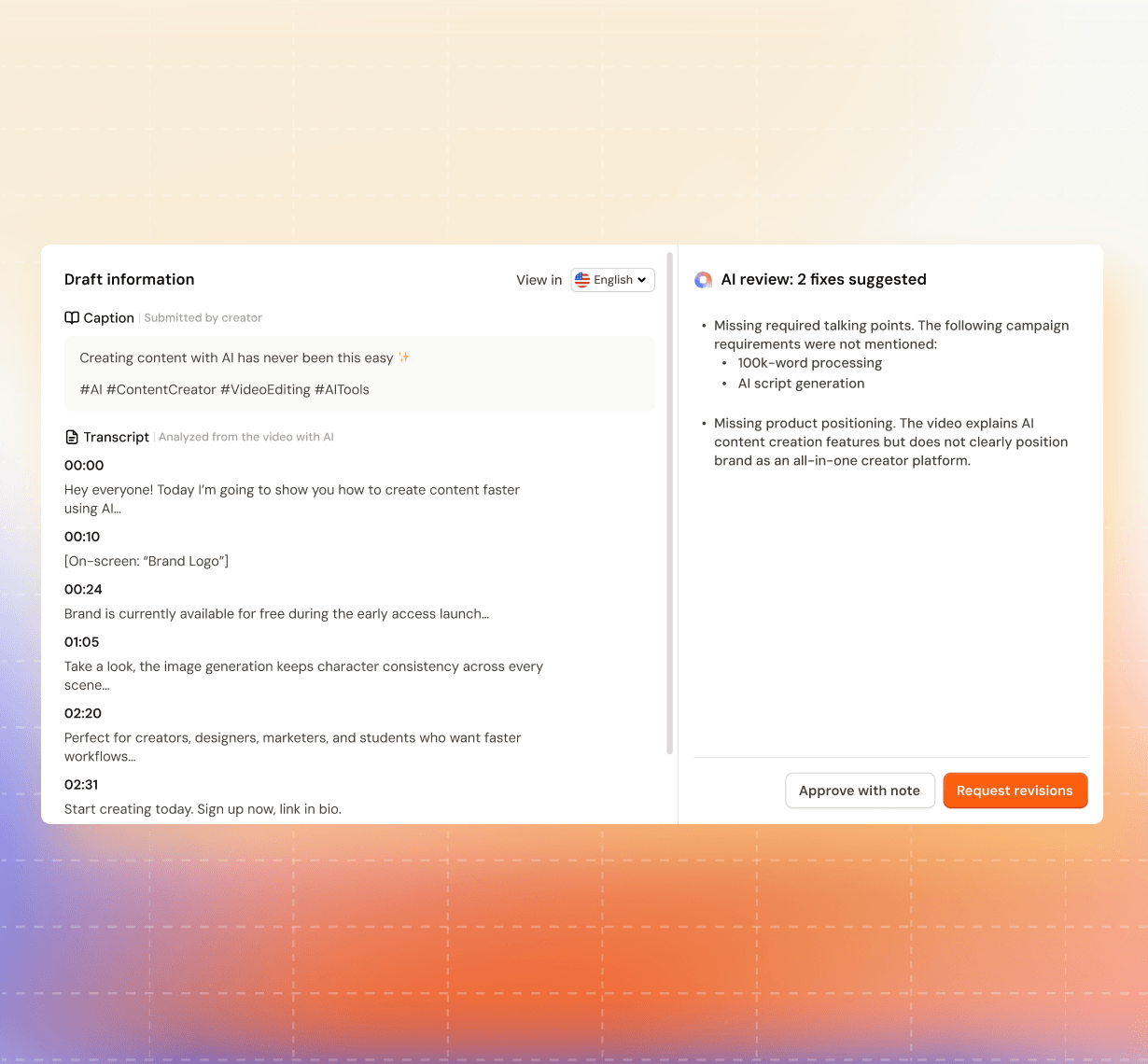
AhaCreator
From creator matching to payment. One connected workflow.
Bring outreach, negotiation, contracts, content review, and campaign tracking together with AhaCreator. Pay creators through the platform and explore how AI supports your team at each stage of a collaboration.
Frequently asked questions
Questions, answered
What is an example of a social media collaboration?
A local fitness studio and a nutrition professional might co-create a short educational video series. The studio provides the setting and distribution to its members, while the professional contributes subject expertise and shares the series with a relevant audience. Their brief would define the topics, accounts, production duties, review process, publication dates, promotion actions, and permissions.
How do you ask a brand or creator to collaborate?
Send a concise proposal explaining why the partnership fits both audiences, the idea and objective, what you are asking the recipient to contribute, what your brand will provide, the expected timing, and whether compensation or another exchange is available. Treat the first message as the start of a discussion, not as a complete agreement.
Should both partners post the same content?
Not necessarily. Each party can publish a version adapted to its audience and channel, provided the core message, required elements, timing, and permissions remain aligned. The brief should identify whether assets will be identical, adapted, jointly published, or simply cross-promoted.
When is a social media collaboration ready to launch?
It is launch-ready when both parties have approved the final assets and confirmed the goal, audience, deliverables, responsibilities, exchange, permissions, publication schedule, promotion commitments, required checks, and contingency contacts in one current record.
Scale creator marketing without scaling busywork
Launch and scale creator partnerships with less manual work and more control.
Sources
- Media - WikipediaUsed for article body