Influencer tracking is the process of recording what creators publish, measuring how that content performs, and connecting creator activity to campaign outcomes such as awareness, traffic, conversions, or revenue. A useful system starts before content goes live: define the objective, assign creator and deliverable IDs, establish attribution methods, and decide when reporting data will be finalized. If you need the wider operational context, see this step-by-step influencer campaign playbook.
Quick answer
To track an influencer campaign, define one primary objective, create creator and deliverable IDs, assign unique links or codes, log every live post, collect performance at consistent checkpoints, reconcile attributed conversions and costs, and report creator- and campaign-level results with explicit coverage and attribution limitations. A spreadsheet is sufficient at manageable volume; automation is valuable when content capture, data joins, and recurring reporting become unreliable or labor-intensive.
Decision rule
Use the simplest workflow that can capture every required deliverable, preserve metric definitions, reconcile attribution, and produce an auditable report without recurring data gaps.
- When You run occasional campaigns with relatively few creators, posts, channels, and attribution sources, and one owner can maintain the records consistently.
- Start with a structured spreadsheet containing creator, deliverable, performance, cost, and attribution tables.
- When The team repeatedly misses temporary content, chases screenshots, or spends substantial time copying post metrics.
- Evaluate automated content capture and post-level performance collection.
- When You run concurrent campaigns or must join creator content with ecommerce, affiliate, web analytics, or multi-currency data.
- Use a platform or integrated analytics workflow that supports the required data sources and exports.
- When You only need website traffic and conversion measurement, not automatic social-content capture.
- A web analytics workflow with standardized creator-level UTMs may be sufficient.
- When The business must estimate incremental impact rather than tracked attribution alone.
- Add an experimental or matched-comparison measurement design; purchasing a campaign dashboard alone does not establish causality.
Comparison
| Criterion | Spreadsheet-led tracking | Platform-supported tracking |
|---|---|---|
| Best fit | Lower campaign volume, limited data sources, and a team able to maintain records consistently | Higher creator or content volume, concurrent campaigns, or recurring reporting complexity |
| Content capture | Post links, screenshots, status checks, and metrics are entered or imported manually | May automatically collect supported public content and post metrics, subject to product and platform rules |
| Attribution | UTMs, code redemptions, affiliate exports, analytics, and order data are reconciled by the team | May create or centralize links and codes and connect supported commerce or analytics data |
| Reporting | Formulas and dashboards can calculate engagement, CPM, ROAS, ROI, and campaign summaries | May provide automatically updated dashboards, calculated metrics, filters, and exports |
| Main advantage | Flexible, inexpensive to operate, and fully controlled by the team | Reduces repetitive collection and centralizes fragmented campaign data |
| Main risk | Manual omissions, inconsistent updates, formula errors, and growing reporting workload | Coverage assumptions, configuration dependencies, integration gaps, and vendor-specific metric definitions |
| Selection test | Can the owner keep every deliverable, metric timestamp, cost, and attributed outcome complete and auditable? | Does the tool support the required networks, formats, identifiers, commerce stack, exports, and attribution rules under real campaign conditions? |
What influencer tracking should tell you
Influencer tracking measures and analyzes creator-led campaign activity against selected business and marketing KPIs. Depending on the objective, that can include published content, reach or views, engagement, website traffic, leads, conversions, revenue, customer acquisition, or other defined outcomes.
A decision-ready report should answer five questions:
- What was supposed to happen? State the campaign objective, audience, required deliverables, dates, budget, and primary KPI.
- What actually went live? Record each post, video, Story, or other deliverable at creator and content level.
- How did the content perform? Consolidate comparable content, awareness, engagement, traffic, and conversion metrics.
- What business outcomes can be attributed to the campaign? Identify the links, codes, analytics rules, or commerce records used to assign results.
- What should change next? Recommend which creators, formats, channels, offers, or tracking processes to retain, test, or stop.
Follower count and engagement can provide context, but they should not replace outcome metrics when the campaign is intended to generate traffic, acquisition, or sales.
Influencer Tracking: How to Turn Creators into Scalable Growth Channels / Admetrics
1. Create the measurement plan before publication
Retrofitting tracking after creators publish can leave missing posts, broken attribution paths, and unclear ROI. Build the measurement plan during campaign setup.
Define the objective and KPI hierarchy
Choose one primary objective and the metric that will determine success. Add secondary metrics only when they help explain the primary result.
- Awareness: reach, impressions, views, completed views, or brand mentions
- Engagement: comments, shares, saves, clicks, or a consistently defined engagement rate
- Traffic: sessions, engaged sessions, landing-page activity, or qualified visits
- Conversion: leads, purchases, subscriptions, code redemptions, or conversion rate
- Commercial return: attributed revenue, ROAS, contribution profit, ROI, or customer acquisition cost
Do not compare creators solely on a metric that is disconnected from the objective. A creator generating strong reach may be effective for awareness even when direct sales are low; a smaller creator may be more valuable in a conversion campaign if their attributed purchases are efficient.
Establish the campaign record
Create stable identifiers rather than relying only on names, which can change or be duplicated. At minimum, record:
- Campaign ID and campaign name
- Creator ID, name, handle, platform, and profile URL
- Deliverable ID, required format, due date, and publication status
- Campaign start and end dates
- Required brand handles, hashtags, disclosures, links, and codes
- Creator fee and any other campaign costs included in your return calculation
- Assigned UTM link, affiliate link, promo code, or other attribution key
- Data owner and source for every metric
Fix the reporting window
Specify when collection begins, when it ends, and when the report will be frozen. Content metrics and conversions may mature at different speeds, so preserve both the metric timestamp and reporting cutoff. If later conversions will be included, define that post-campaign attribution window in advance rather than extending it selectively after seeing the results.
AMA Influencer Marketing Tracker Toolkit - American Marketing Association · Influencer Tracking: How to Turn Creators into Scalable Growth Channels / Admetrics
2. Capture every deliverable and its performance record
Use one row per deliverable or post. This preserves the relationship between a creator, a specific piece of content, its metrics, and any attributed outcome.
For each published item, capture:
- Creator ID and deliverable ID
- Platform and content format
- Live URL or content reference
- Required and actual publication dates
- Publication status
- Screenshot or archived asset where permitted
- Disclosure, hashtag, mention, and link checks
- Date and time each metric snapshot was taken
- Reach, impressions, views, and video-view measures available from the source
- Likes, comments, shares, saves, and total engagements
- Link clicks, code redemptions, conversions, and revenue where available
Log the post when it goes live rather than waiting until the campaign ends. Then collect performance at consistent checkpoints so creators are compared over equivalent post-publication periods wherever possible. Do not mix a creator’s first-day performance with another creator’s 30-day total without labeling the difference.
Reconcile expected and observed content
Compare the deliverable plan with the live-post record:
- Is every required deliverable present?
- Was anything published late, deleted, or replaced?
- Did the creator use the expected handle, hashtag, disclosure, link, or code?
- Are multiple posts accidentally recorded as one deliverable?
- Were organic reposts or paid amplification mixed into creator-post metrics?
Automatic collection can reduce profile checking, screenshot requests, and manual data entry. However, coverage is never something to assume. Public-content systems may be unable to observe private accounts, Close Friends posts, direct messages, deleted content, unpublished material, or content types restricted by a social platform. Some systems also rely on correct tags, mentions, keywords, creator opt-ins, or campaign enrollment. Record missing content explicitly instead of treating a blank cell as zero performance.
Influencer Tracking Platform: Track Campaign Content & Performance · 10 Influencer Tracking Tools To Track Influencer Campaigns
3. Connect creator activity to traffic, conversions, and revenue
Attribution should identify the specific path by which a result was assigned to a creator. Use multiple methods when customer behavior makes a single path incomplete, but keep the resulting categories separate.
Unique UTM links
Give each creator a consistently structured URL, such as a shared campaign value plus a creator-specific content or source value. Web analytics can then report sessions and configured conversion events associated with that tagged traffic.
Check links before launch, preserve redirect parameters, and avoid changing naming conventions mid-campaign. A UTM record demonstrates that a tracked visit followed the tagged link; it does not capture people who saw the content and later visited through an untagged route.
Affiliate or tracking links
Creator-specific affiliate links can connect clicks, orders, and revenue within the system’s attribution rules. Confirm the attribution window, cross-device behavior, returns handling, and which interaction receives credit when several marketing touchpoints occur.
Unique promo codes
A creator-specific code can identify purchases even when the customer does not use the creator’s link. Codes can also be shared beyond the original audience, omitted at checkout, or replaced by another offer, so code revenue should be labeled as code-attributed revenue rather than total incremental influence.
Commerce and customer data
Where systems can be joined safely, reconcile order IDs, discounts, refunds, cancellations, taxes, shipping, and currency before calculating revenue or return. Decide whether the report uses gross sales, net sales, or contribution profit and apply that definition consistently.
Interpret attribution honestly
Links and codes establish defined attribution paths; they do not prove that every credited purchase was caused by the creator or that untracked customers were unaffected. Stronger causal claims require an incrementality design, such as a suitable holdout, matched comparison, or controlled test. Keep observed attribution and estimated incremental impact as separate report fields.
Influencer Tracking Platform: Track Campaign Content & Performance · Influencer Tracking: How to Turn Creators into Scalable Growth Channels / Admetrics · 10 Influencer Tracking Tools To Track Influencer Campaigns
4. Calculate creator and campaign performance
Calculate metrics first at the post or creator level, then roll them up to the campaign. Preserve raw numerators and denominators so stakeholders can audit the result.
Core calculations
Use definitions appropriate to the available platform data and label them in the report:
- Total engagements = likes + comments + shares + saves, using only consistently available components
- Engagement rate by reach = total engagements ÷ reach × 100
- Click-through rate = tracked clicks ÷ the chosen exposure measure × 100
- Conversion rate = attributed conversions ÷ tracked clicks × 100
- Cost per engagement = included campaign cost ÷ total engagements
- CPM = included campaign cost ÷ impressions × 1,000
- Cost per acquisition = included campaign cost ÷ attributed acquisitions
- ROAS = attributed revenue ÷ included campaign cost
- Revenue-based ROI = (attributed revenue − included campaign cost) ÷ included campaign cost × 100
- Contribution-profit ROI = (attributed contribution profit − included campaign cost) ÷ included campaign cost × 100
ROAS reports revenue relative to spend; it does not account for product cost or other margin effects. A contribution-profit ROI is usually more decision-useful when reliable margin data is available. Whichever approach you choose, list the included cost categories—for example, creator fees, gifted-product cost, production, paid amplification, platform fees, and allocated labor—and do not change them between creators.
Roll up without hiding variation
A campaign summary can show total spend, content units, reach or views, engagement, clicks, conversions, revenue, ROAS, and ROI. It should also retain creator-level results because an acceptable campaign average can hide a few strong performers and many weak ones.
Compare creators on the campaign’s primary outcome first, then use diagnostic metrics to explain the result. For example, low sales may reflect weak reach, low click-through, poor landing-page conversion, tracking loss, or an offer problem. Those situations require different decisions.
Treat EMV as an estimate
Earned media value can be included when the organization has an agreed formula, but its assumptions should be disclosed. EMV is model-dependent and should not be presented as cash revenue or combined with attributed sales as though both were realized financial return.
AMA Influencer Marketing Tracker Toolkit - American Marketing Association · 10 Influencer Tracking Tools To Track Influencer Campaigns
5. Choose a spreadsheet or tracking platform
A spreadsheet can be a complete campaign tracker when the team can reliably maintain it. A structured workbook can hold creator records, deliverable IDs, post links, performance inputs, spend, revenue, calculated metrics, and campaign summaries without a dedicated influencer platform.
Platform support becomes more useful as the number of creators, posts, concurrent campaigns, channels, and data sources increases. Available products may centralize content capture, post-level analytics, tracking links or codes, commerce data, dashboards, and exports. Capabilities and coverage vary: some tools focus on web traffic, others on affiliate sales, social listening, content capture, or end-to-end campaign reporting.
Do not choose a platform from its feature count alone. Test it against your actual platforms, content formats, account types, tagging practices, commerce stack, attribution requirements, export needs, currencies, and reporting definitions. Vendor claims about automation or coverage apply to that product’s stated conditions and should not be generalized to every tracking tool.
AMA Influencer Marketing Tracker Toolkit - American Marketing Association · AI-Powered Influencer Marketing Platform | Traackr · Influencer Tracking Platform: Track Campaign Content & Performance · 10 Influencer Tracking Tools To Track Influencer Campaigns
6. Run quality checks before reporting results
Before distributing the report, complete a documented quality review:
- Reconcile deliverables: Match required posts against observed posts and explain every missing, deleted, late, or substituted item.
- Validate dates: Confirm that content and conversions fall inside the stated campaign and attribution windows.
- Check identifiers: Look for duplicate creators, posts, deliverables, orders, links, and promo codes.
- Verify metric definitions: Ensure reach, impressions, views, engagements, revenue, ROAS, and ROI mean the same thing across the report.
- Normalize observation periods: Label unequal post ages or avoid direct comparisons until comparable windows are available.
- Reconcile commerce data: Account for cancellations, refunds, discounts, taxes, shipping, currencies, and attribution overlap according to the reporting policy.
- Confirm costs: Include the cost categories promised in the methodology and flag estimates separately.
- Label missing data: Distinguish zero, unavailable, not applicable, and not yet reported.
- Document attribution: State whether each outcome came from a UTM, affiliate link, code, platform model, survey, or experimental estimate.
- Write the decision: Identify what to repeat, what to test, what to stop, and what measurement gap must be fixed next time.
The report should end with limitations, not bury them. Content-access gaps, missing creator analytics, tracking loss, and attribution assumptions materially affect how confidently stakeholders can interpret results.
Influencer Tracking Platform: Track Campaign Content & Performance · AMA Influencer Marketing Tracker Toolkit - American Marketing Association · Influencer Tracking: How to Turn Creators into Scalable Growth Channels / Admetrics
Conclusion
Effective influencer tracking is less about collecting every available metric and more about building a reliable chain from campaign objective to creator content, audience response, attributed outcomes, cost, and action. Start with a controlled spreadsheet when volume and complexity are low. Move to platform-supported tracking when manual content capture, fragmented sales data, or recurring reporting becomes difficult to maintain. In either case, document attribution and coverage limits so stakeholders understand what the report proves—and what it does not.
AhaCreator
From creator matching to payment. One connected workflow.
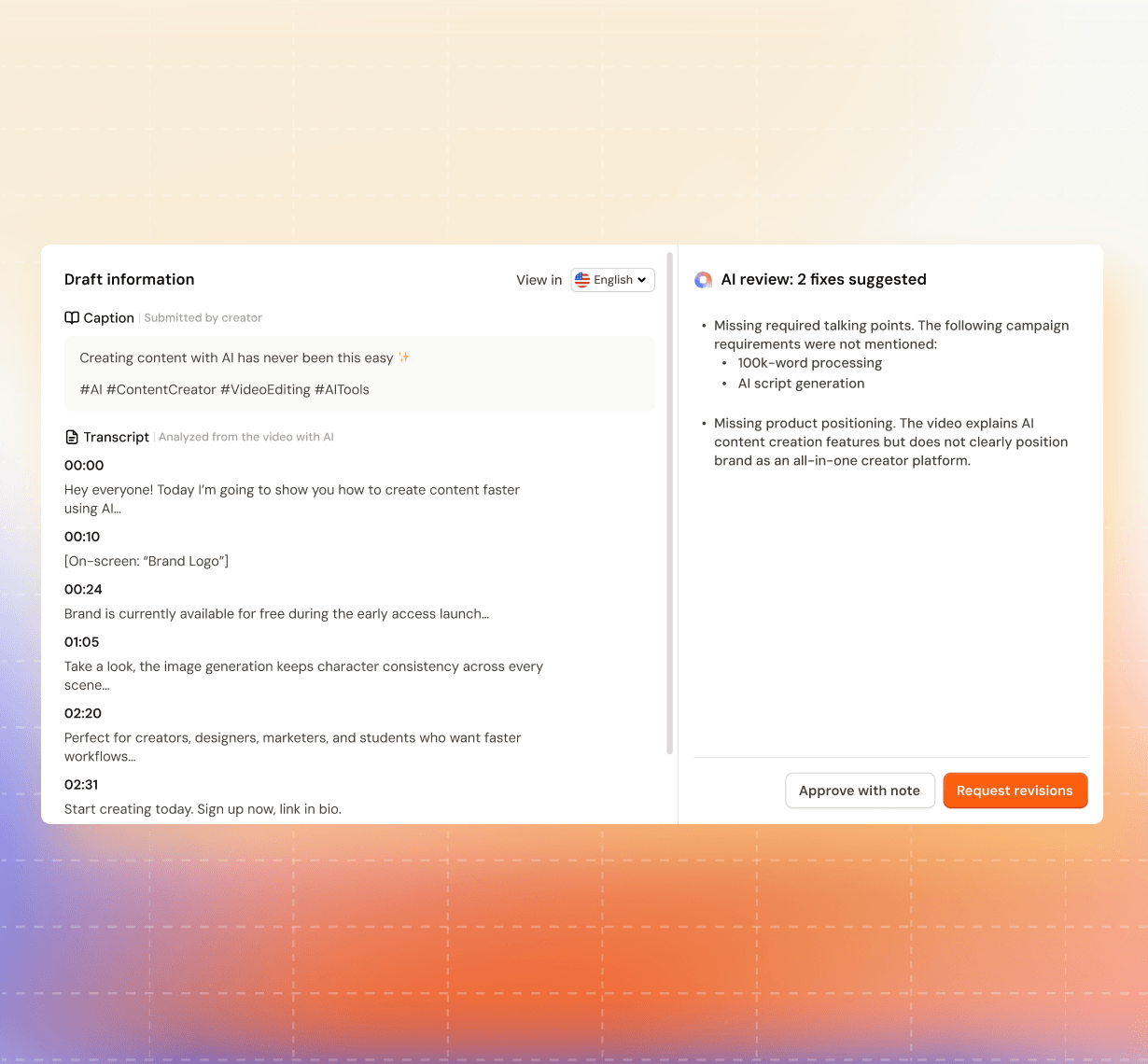
Bring outreach, negotiation, contracts, content review, and campaign tracking together with AhaCreator. Pay creators through the platform and explore how AI supports your team at each stage of a collaboration.
Frequently asked questions
Questions, answered
What is influencer tracking?
Influencer tracking is the structured measurement of creator content and campaign performance against defined KPIs. It can include publication status, reach, engagement, traffic, conversions, revenue, cost, and return, depending on the campaign objective.
Influencer Tracking: How to Turn Creators into Scalable Growth Channels / Admetrics
How do you track influencer sales?
Assign each creator a unique affiliate or UTM-tagged link and, where appropriate, a unique promo code. Reconcile clicks, orders, revenue, refunds, and the applicable attribution window. Report link-attributed and code-attributed sales separately when overlap is possible.
Influencer Tracking Platform: Track Campaign Content & Performance · 10 Influencer Tracking Tools To Track Influencer Campaigns
Can influencer tracking prove ROI?
It can calculate return from outcomes attributed under a stated tracking method. That is not automatically proof of incremental impact. Clearly define attributed revenue or contribution profit, included campaign costs, and attribution limitations; use controlled testing when a causal incrementality claim is required.
Influencer Tracking: How to Turn Creators into Scalable Growth Channels / Admetrics
Can I track an influencer campaign in a spreadsheet?
Yes. A spreadsheet can maintain creator and deliverable IDs, post links, reach, engagement, clicks, conversions, revenue, spend, ROAS, ROI, and campaign summaries. It works best when campaign volume is low enough for the team to update and audit the data consistently.
AMA Influencer Marketing Tracker Toolkit - American Marketing Association
Why might an influencer tracking tool miss posts?
Tools may be unable to access private accounts, Close Friends content, direct messages, deleted posts, unpublished content, or platform-restricted formats. Some also require the correct hashtag, mention, creator opt-in, or campaign configuration. Missing-data reconciliation remains necessary even with automation.
Influencer Tracking Platform: Track Campaign Content & Performance · 10 Influencer Tracking Tools To Track Influencer Campaigns
Scale creator marketing without scaling busywork
Launch and scale creator partnerships with less manual work and more control.
Sources
- AMA Influencer Marketing Tracker Toolkit - American Marketing AssociationUsed for article body, quick answer, decision rule, comparison matrix
- Influencer Tracking Platform: Track Campaign Content & PerformanceUsed for article body, quick answer, decision rule, comparison matrix
- Influencer Tracking: How to Turn Creators into Scalable Growth Channels / AdmetricsUsed for article body, quick answer
- 10 Influencer Tracking Tools To Track Influencer CampaignsUsed for article body, decision rule, comparison matrix
- AI-Powered Influencer Marketing Platform | TraackrUsed for article body, comparison matrix